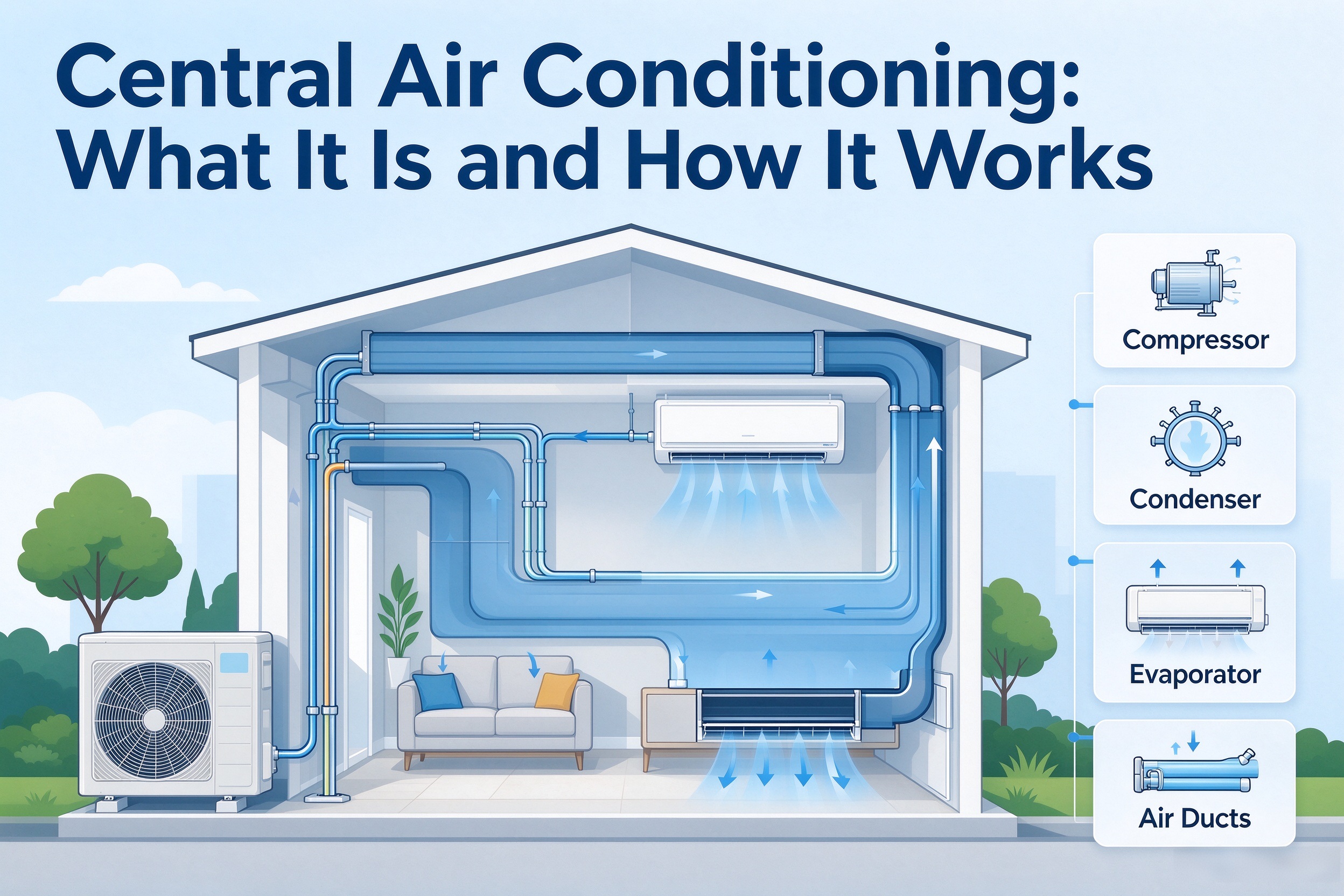
Central Air Conditioning: What It Is and How It Works
A central air conditioner system is one of those home investments you notice most when it stops working. This guide explains what it is, how the cooling cycle actually moves heat out of your home, and what keeps a system running efficiently season after season — without the jargon.
What you’ll find below: a plain-language definition → the refrigeration cycle step by step → the four components that make it work → split vs. packaged layouts → efficiency ratings → a maintenance rhythm that protects your equipment → how to size a replacement correctly.
What is central air conditioning, in plain terms
What is central air conditioning? It is a whole-home cooling method that treats air at a single indoor unit and then distributes that conditioned air through a network of ducts to multiple rooms. Instead of cooling one window or one wall at a time, a central air conditioner system gives you uniform temperature control from one thermostat, using a shared supply-and-return duct path.
The phrase “air conditioning” is slightly misleading. The equipment does not manufacture “cold.” It removes heat and humidity from indoor air and rejects that heat outdoors. Once you see the process as heat transfer rather than cold production, everything about maintenance, efficiency, and troubleshooting starts to make more sense.
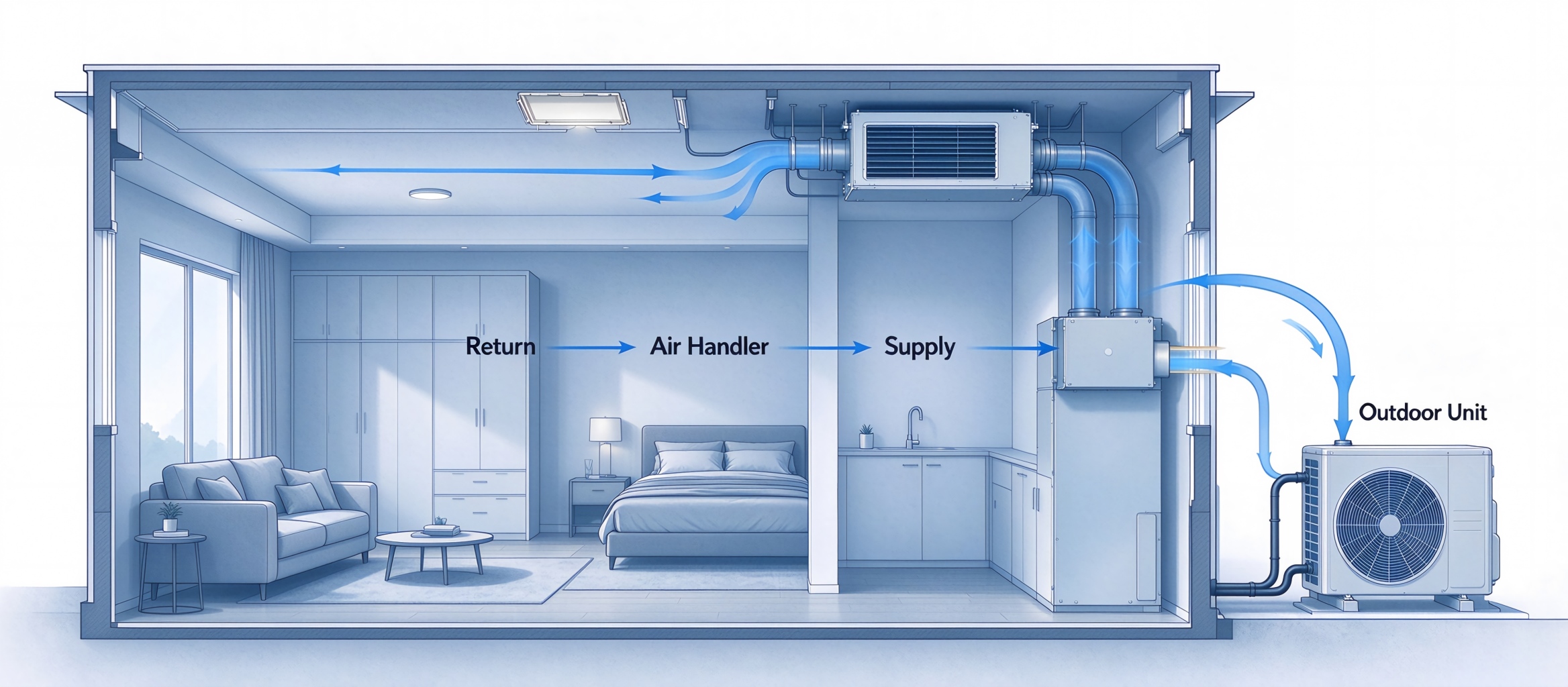
Airflow path diagram
How does central air work: the cooling cycle in four moves
How does central air work in practice? The answer is a closed refrigerant loop that changes pressure and phase to pick up heat indoors and drop it outdoors. Here is the sequence, kept as simple as the physics allows.
Step 1 · The thermostat calls for cooling
When the indoor temperature rises above your set point, the thermostat closes the circuit and the system starts. The indoor blower and the outdoor compressor energize together. From this moment, the entire loop is working as one machine.
Step 2 · Warm indoor air crosses the evaporator coil
The blower pulls room air through return ducts and pushes it across the evaporator coil, a finned coil inside the indoor air handler. The coil contains low-pressure liquid refrigerant that is colder than the air. Heat moves from the air into the refrigerant, the refrigerant evaporates into a gas, and the air leaves the coil cooler and drier. A filter sits upstream of the coil to catch dust before it can coat the fins.
Step 3 · The compressor raises the pressure and temperature
The gaseous refrigerant travels to the outdoor unit, where the compressor squeezes it to a much higher pressure. This step is the heart of the operation: raising the refrigerant’s temperature above the outdoor air temperature is what allows heat to flow the “wrong way” — from a cool house to a hot yard. Without the compressor, the loop has no temperature difference to drive heat rejection.
Step 4 · The condenser releases heat and the cycle resets
Hot, high-pressure gas enters the condenser coil in the outdoor unit. The condenser fan pulls outdoor air across the coil, the refrigerant gives up heat to the atmosphere, and it condenses back into a liquid. An expansion device then drops the pressure and temperature before the refrigerant re-enters the evaporator, and the cycle repeats until the thermostat is satisfied.
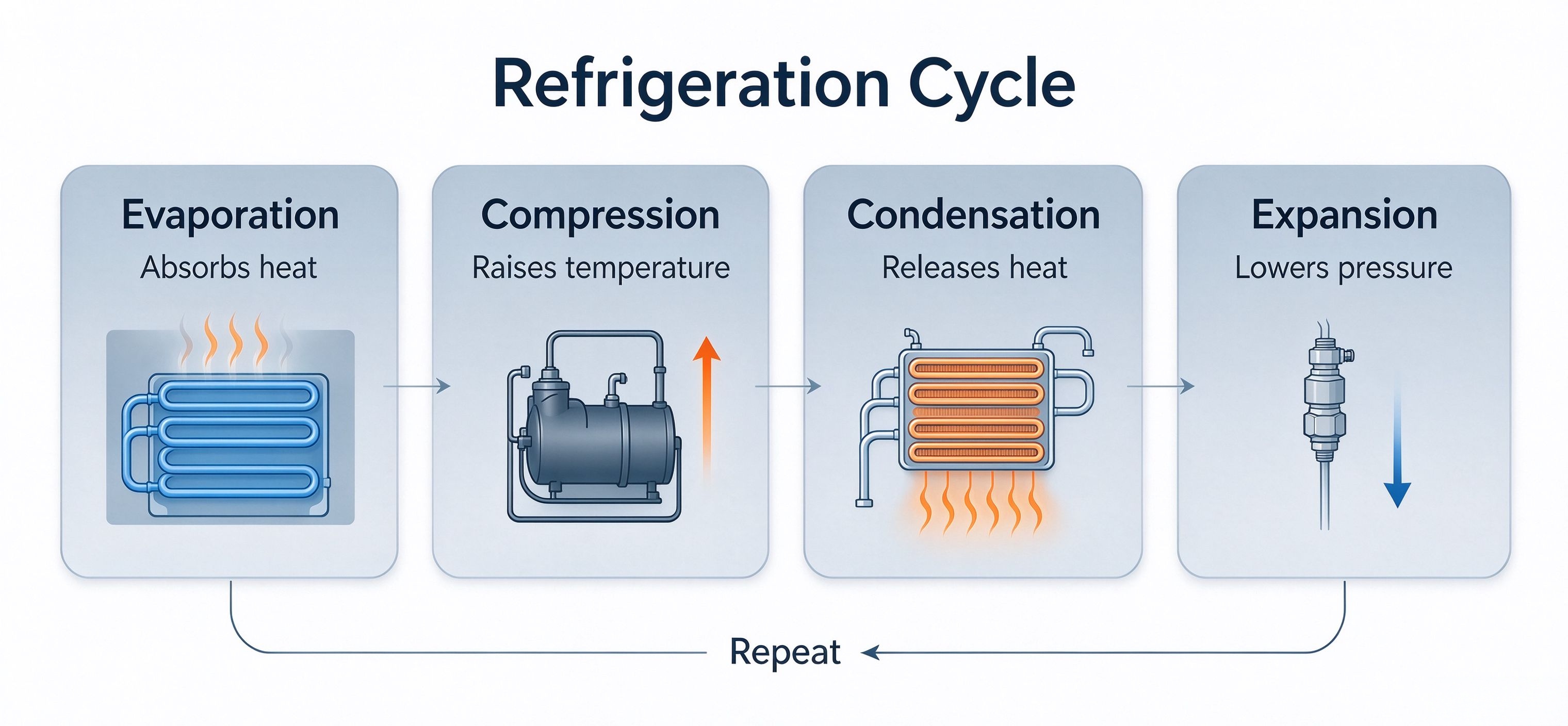
Refrigeration cycle breakdown
The four components that make a central air conditioner system work
A central air conditioner system is built around four primary mechanical components that form a sealed refrigerant circuit. Understanding what each one does makes it easier to see why filters, coils, and airflow matter so much.
| Component | Location | Job in the loop |
|---|---|---|
| Compressor | Outdoor unit | Raises refrigerant pressure and temperature so heat can be rejected outdoors |
| Condenser coil | Outdoor unit | Releases heat to outdoor air and condenses refrigerant back to liquid |
| Expansion device | Indoor / outdoor transition | Drops refrigerant pressure and temperature before the evaporator |
| Evaporator coil | Indoor air handler | Absorbs heat and moisture from indoor air as refrigerant evaporates |
The blower and ductwork are not part of the sealed refrigerant circuit, but they are equally important to comfort. A perfectly charged system with a dirty blower wheel or crushed duct still delivers weak airflow and poor cooling. Airflow problems can reduce system efficiency by up to 15 percent.
Split systems vs. packaged systems: the two common layouts
Most homes use one of two physical arrangements. The choice affects installation, service access, and how the equipment fits into the building.
Split system
In a split layout, the condenser and compressor sit outdoors, while the evaporator coil and blower sit indoors — usually in an air handler, furnace, attic, or closet. Refrigerant lines connect the two halves. This is the most common arrangement in residential retrofits because the indoor and outdoor sections can be placed independently.
Packaged system
A packaged unit puts the evaporator, condenser, compressor, and blower into a single cabinet, typically on the roof or beside the foundation. Ductwork still delivers air throughout the home. Packaged systems can simplify installation when indoor mechanical space is limited.
Efficiency ratings that actually matter when you compare equipment
SEER2 is the current seasonal efficiency metric for central air conditioners in the United States. It estimates average cooling efficiency across a range of outdoor temperatures rather than a single laboratory condition. Higher SEER2 means more cooling per unit of electricity, but the rating is only useful when the equipment is sized and installed correctly.
Current central air conditioners commonly fall in a SEER2 range from roughly 13.4 up to the high teens or low 20s, depending on the model and region. A higher rating usually carries a higher upfront cost; the right balance depends on climate, electricity prices, and how long you plan to stay in the home.
A sizing note worth repeating: two systems with the same SEER2 can perform very differently if one is oversized. An oversized unit short-cycles, removes less humidity, and wears out faster. Proper sizing is based on a room-by-room load calculation — not square footage alone — factoring insulation, window orientation, ceiling height, and local climate.
A maintenance rhythm that protects efficiency and equipment life
Central air equipment is durable, but it is not maintenance-free. The tasks below are the ones that consistently prevent the most common performance losses.
Monthly to quarterly: the air filter
A clogged filter restricts airflow, forces the blower and compressor to work harder, and can eventually freeze the evaporator coil. Replace or clean the filter every one to three months during heavy cooling season; homes with pets or allergy sufferers may need more frequent changes.
Seasonally: outdoor coil and clearances
The condenser coil needs unobstructed airflow to reject heat. Clear leaves, grass clippings, and pollen from the coil, and keep at least two feet of clear space around the cabinet. Trim shrubs and remove stored items leaning against the unit.
Annually: a professional tune-up
Once a year, before the cooling season, have a technician check refrigerant charge, clean the evaporator and condenser coils, inspect electrical connections, and verify airflow. A tune-up is also the right time to confirm the condensate drain is flowing freely; a clogged drain line is a leading cause of water damage and shutdowns.
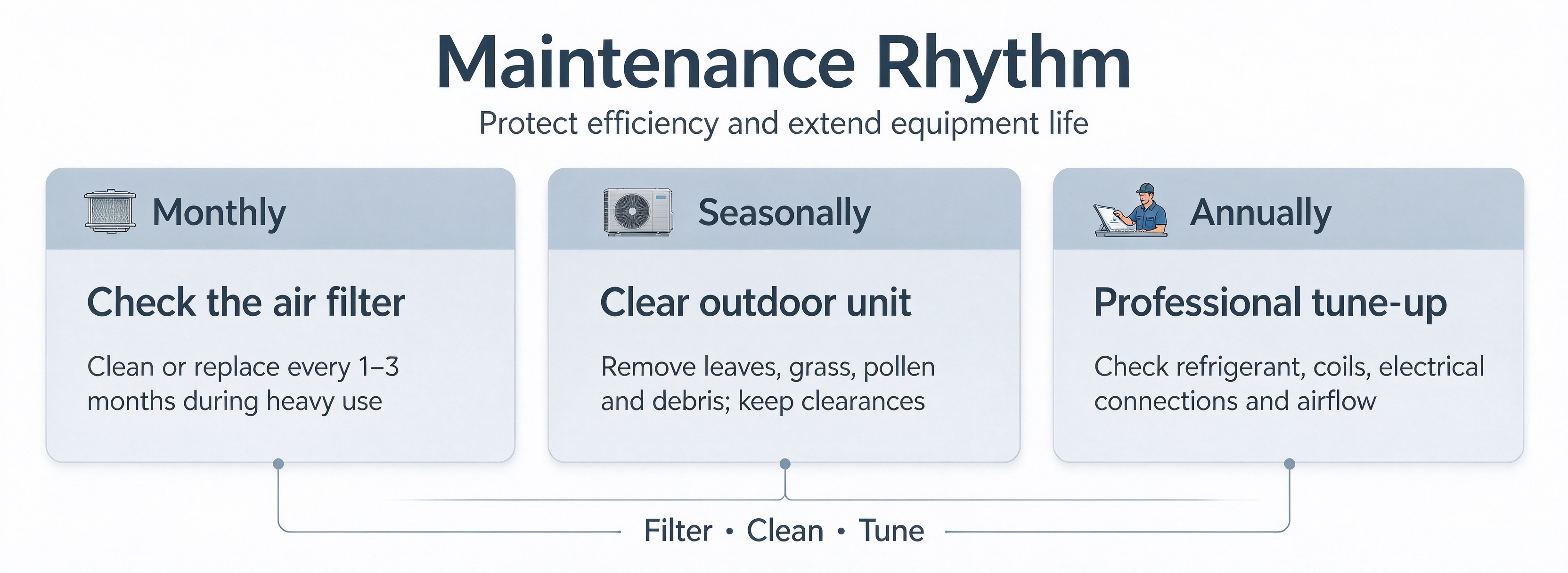
Maintenance rhythm quick-reference chart
When the house is not cooling: a short, safe diagnostic list
Before calling for service, check the simple causes. Many “broken AC” calls turn out to be a tripped breaker, a thermostat in the wrong mode, or a filter that has not been changed.
No cooling at all
Check the thermostat setting, the indoor air handler power switch, and the breaker at the panel. A tripped breaker or a thermostat left in “fan only” is more common than a failed compressor.
Weak airflow from vents
A dirty filter, closed registers, or a blocked return are the first suspects. If airflow is weak at every vent after a filter change, the blower or duct system needs attention.
Ice on the indoor coil or refrigerant line
Frozen equipment usually points to restricted airflow or low refrigerant charge. Turn the cooling off and let the ice melt, then address the filter or call a technician. Do not keep running the system with ice present.
What to look for when replacing or specifying equipment
If you are comparing replacement options or sourcing equipment for a project, a few practical checks separate a good decision from an expensive compromise.
Load calculation first. Ask for a room-by-room load calculation rather than a “rule of thumb” tonnage. The calculation accounts for insulation, glazing, orientation, and local design temperatures.
Match the indoor and outdoor sections. A high-efficiency outdoor unit paired with an older indoor coil or air handler may not deliver its rated SEER2. Matched systems protect both performance and warranty coverage.
Confirm the refrigerant and service access. Refrigerant regulations continue to evolve. Make sure the equipment you specify uses a refrigerant that your service network can support, and that replacement parts are readily available in your market.
Plan the ductwork, not just the box. Duct leakage and undersized returns can erase the efficiency gains of a premium condenser. If the existing ducts are accessible, a pressure test is worth the modest added cost.
Refria · Equipment & Parts
Need help specifying a central air conditioner system or sourcing the right components?
Whether you are replacing an existing unit, equipping a project, or tracking down a specific part, our team can help you compare options and confirm compatibility before you commit. Reach out and tell us what you are working with.
No obligation. Tell us your capacity range, refrigerant type, or the part number you are looking for, and we will respond with availability and next steps.
Refria supplies HVAC equipment and parts to contractors, distributors, and project teams. This guide is written for general educational purposes; installation and refrigerant work should be performed by licensed professionals in accordance with local codes.
HVAC Replacement Cost in 2026: What Homeowners Actually Pay